Guide to New Jersey Marriage Records
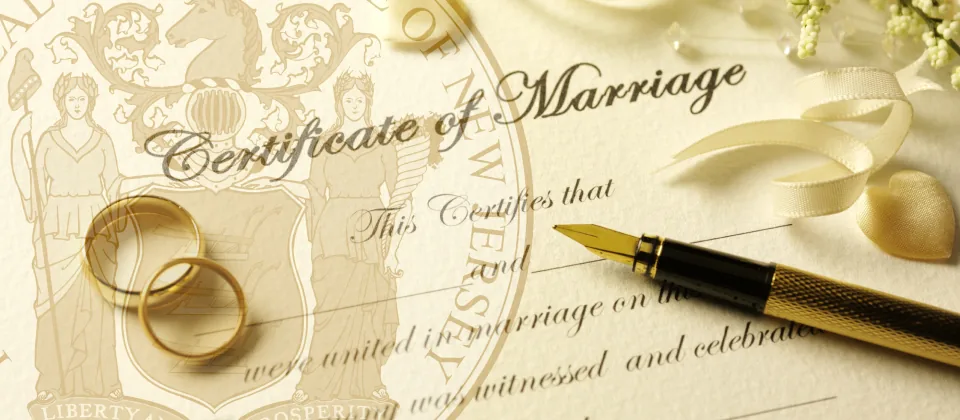
Marriage records represent the official documentation for marriages that occurred in New Jersey. Depending on the type and date of a marriage record, it can contain information such as the:
- Names of the spouses
- Date and location of the marriage
- Ages of the spouses
- Residences of the spouses
- Birthplaces of the spouses
- Parental information
- Previous marital history
- Witnesses information
- Marriage officiant information
A marriage record is often used as a general term for official documentation of marriage. A marriage license is a marriage record issued to applicants (a couple) as a permit authorizing them to get married. A marriage certificate is a record attesting that a marriage has taken place.
New Jersey residents obtain marriage records for different reasons. For instance, a certified marriage certificate serves as legal proof of marital status. It also supports a legal name change and helps establish a relationship for estate or benefit matters. New Jersey marriage records are also useful for genealogy because older records may identify parents, residences, ages, and spouses' birthplaces.
Types of Marriage Records in New Jersey
| Record Type | Purpose | Issued by | Validity/Notes |
|---|---|---|---|
| Marriage License | Authorization to marry | Local Registrar | Valid for 30 days. |
| Marriage Certificate | Official proof that the marriage occurred | Office of Vital Statistics and Registry, or the Local Registrar | Official proof of marriage for legal name changes and administrative claims. |
| Genealogical Marriage Record | Historical and family history research | New Jersey State Archives | Available for records older than 50 years. |
Marriage records in New Jersey generally fall into one of the following categories:
Marriage Certificates
A marriage certificate is an official record proving that the individuals named on it were married in the state of New Jersey. This record includes information on the spouses' names, the date and county of marriage, the officiant, and the witnesses.
A certified copy of this record is needed when official proof of a marriage is required. Examples include when evidence of marital status is required for a legal name change or other government or administrative purposes.
Certified copies of New Jersey marriage certificates are issued by the New Jersey Office of Vital Statistics and Registry and by the Local Registrar in the municipality where the marriage occurred.
Marriage Licenses
A New Jersey marriage license is the legal authorization that the state requires of a couple before marrying in New Jersey. Unlike a marriage certificate, which confirms that a marriage took place, a marriage license gives a couple permission to marry.
Marriage licenses in the Garden State are issued by a Local Registrar and are valid for 30 days after the date of issuance.
Are Marriage Records Public in New Jersey?
New Jersey marriage records are not fully public and are exempt from standard Open Public Records Act (OPRA) requests. The state classifies these records as confidential vital documents.
Access to New Jersey marriage records is divided into the following categories based on the record's age and the type of copy requested.
| Record Classification | Time Frame Range | Access Authorization Rules |
|---|---|---|
| Non-Genealogical (Restricted) | Marriages within the past 50 years | Limited to immediate family members, legal spouses, or authorized legal entities with proof of relationship |
| Genealogical (Public) | Marriages that occurred over 50 years ago | Accessible to the general public, provided both individuals listed on the record are deceased. |
Due to restrictions on marriage records in New Jersey, the state blocks third parties from obtaining certified copies unless they can submit an authorized court order, a signed power of attorney, or clear documentation of direct lineage.
What Information Is Included in a Marriage Record?

The information available in a New Jersey marriage record depends on when the record was created and which version of the record is obtained. A marriage record may contain the following details:
- The full names of both spouses
- The date and municipality where the marriage occurred
- The county associated with the municipality or marriage record, where included
- The marriage license or record number
- The name or identifying information of the officiant
- The signatures or information of witnesses;
- The spouses' ages, residences, and birthplaces
- Previous marital or domestic status
- Parents' names and, on some records, parents' places of birth
Historical marriage records may include additional details, such as the bride's and groom's ages and residences, parents' names, the date and place of marriage, and the officiant.
Some information, such as the Social Security numbers and specific medical and blood test details (if noted historically), collected during the marriage license process, is confidential and not disclosed in marriage record requests.
How to Find Marriage Records in New Jersey
Step 1: Identify the Marriage Details
Obtain the full legal names of both parties as recorded in the marriage certificate. You will also need the approximate month and year of the event, as well as the city and county where the marriage occurred.
Step 2: Find the Record Custodian
Depending on the age of the record, New Jersey marriage records may be available in the following locations:
- State vital records office: The Office of Vital Statistics and Registry of the New Jersey Department of Health maintains centralized marriage records dating back to 1918.
- County and municipal registrars: Local offices maintain duplicate files of marriages that physically occurred within their city or township limits.
- State archives: The New Jersey State Archives holds all historical marriage files dating from May 1848 to 1912.
- County-specific offices and archives: Some New Jersey counties maintain their own historical marriage indexes or archives, particularly for records predating 1901.
Step 3: Choose How to Search
You may submit a marriage record request via the following options:
- Online: Via the state's approved vendor, VitalChek, or a municipality's own online portal (where available).
- By mail: Use the appropriate application form and submit it to the state vital statistics office in Trenton.
- In person: Many municipal vital statistics offices offer same-day walk-in service. Applicants may also visit the Vital Statistics office’s walk-in center at 140 E. Front Street, Trenton.
- Through approved third-party or historical databases: Platforms such as the New Jersey State Archives' online indexes or genealogy sites like FamilySearch allow users to search older New Jersey marriage records.
Step 4: Submit a Record Request
Provide a completed application form and pay the processing fee. The fee starts at $25 for the first copy and $2 for each additional copy ordered at the same time. Include a clear, unexpired, and valid photo ID and proof of official relationship. Processing times vary from same-day for walk-in requests to 6-8 weeks for online applications and up to 12 weeks for applications sent by regular mail. Local office processing times vary.
How to Get a Certified Marriage Certificate in New Jersey
A certified copy of a New Jersey marriage certificate can only be obtained by:
- Spouses named on the certificate
- Parents or legal guardians
- Children
- Grandchildren
- Siblings
- Authorized attorney or representative
To obtain a copy, an applicant must submit a valid, unexpired government photo ID, such as a driver's license or passport. If a photo ID is unavailable, they may submit two separate utility bills or official correspondence showing your current legal address.
Applications may be completed via VitalChek (New Jersey's approved third-party vendor) online or by mail. Completed application forms submitted via mail must be sent to the NJDOH address stated on the forms. Alternatively, in-person requests can be submitted at the NJDOH walk-in center in Trenton. Note that the state Office of Vital Statistics charges $25 for the initial search and first certified copy.
Certified copies of New Jersey marriage records feature a raised state seal and are typically required to modify estate titles, execute immigration sponsorships, update driver's licenses, and process name changes with the Social Security Administration.
How to Get a Marriage License in New Jersey
Applications for New Jersey marriage licenses are made at the office of the Local Registrar in the municipality where either applicant lives. If either applicant is an out-of-state resident, the application must be made in the municipality where the marriage ceremony is intended to be conducted.
To qualify as applicants, both parties must be at least 18 years of age, and neither may be married, in a civil union, or in a domestic partnership. The application process includes submitting proof of identity, such as a driver’s license, a passport, or a state or federal ID. Moreover, if the applicant is a New Jersey resident, they also need proof of residency. U.S. citizens have to provide a Social Security number. Additionally, a witness aged at least 18 is required to attend the application appointment to sign under oath.
The marriage license application costs $28. From the time the application is filed, there is a waiting period of about 72 hours before the license can be issued. Furthermore, the license is valid for 30 days.
A New Jersey marriage must be solemnized by an individual or organization authorized under New Jersey law. The authorized person may be a judge, a clergy member, or a state-certified civil celebrant. The certificate must be signed by at least two witnesses present at the ceremony.
Who Can Request Marriage Records?
Only individuals with direct, provable legal interest can access non-genealogical marriage records in New Jersey. Such persons include:
- The individuals listed on the marriage record.
- Immediate family members (parents, children, grandchildren, or siblings).
- Authorized legal representatives or attorneys acting on behalf of an estate.
- State or federal government agencies requiring confirmation for official programs.
- Genealogists or historical researchers, provided the record meets the age thresholds for genealogical classification.
In addition to the listed parties, anyone seeking access to non-genealogical marriage records must provide additional authorization. This may include an original court order signed by a judge or a notarized power of attorney from an eligible family member, along with the required application forms and proof of identity.
Free and Online Marriage Record Searches

Although the State of New Jersey does not provide a free public online name search for current marriage records, historical records are different.
The New Jersey State Archives offers free online indexes for marriages before the 1900s. These records are searchable by name, county, and year. Genealogical databases such as FamilySearch also host some digitized New Jersey marriage indexes. Index searches confirming that a marriage occurred and other basic details such as names, date, and county are generally available at no fee.
Note that records obtained from these sources are non-certified and cannot be used for legal purposes. A fee is required when an official copy, certified copy, or formal state search is requested.
If the precise date or location for a marriage record is unavailable, historical researchers can begin by searching the names of the spouses in the state archives database and filtering results by the approximate date or place. They may also check neighboring counties and use the officiant's or witness's name, if known.
Common Law Marriage in New Jersey
Regardless of how long a couple has lived together or presented themselves as married, common law marriages contracted within New Jersey after December 1, 1939, are not legally valid. Consequently, there are no corresponding state marriage licenses or certificates to search for couples who consider themselves common law married in New Jersey.
However, the state recognizes out-of-state common law marriages validly established in other states where such marriages are permitted.
How to Correct an Error on a Marriage Record
One or both spouses named on a marriage record may request a correction on the record. In certain cases, the officiant who signed the original certificate may also request an amendment of the record.
Common types of errors in New Jersey marriage records include misspelled names, incorrect dates, wrong locations, and clerical or typographical mistakes made by the officiant or registrar.
To correct an error, send a completed Application to Amend a New Jersey Vital Record along with documentary proof of correct information (such as a birth certificate, prior court order, or other government-issued record supporting the requested change) to:
New Jersey Department of HealthVital Statistics and Registry
Attention: Vital Record Modifications Unit
P.O. Box 370
Trenton, NJ 08625-0370
New Jersey charges $2 to process a legal-name change amendment through the state office. If a new certified certificate is requested afterward, the first copy is $25, and additional copies of the same certificate ordered at the same time are $2 each. Other correction fees may vary by municipality and type of amendment.
Marriage Records and Name Changes
A certified marriage certificate may be used as evidence of a person's name change when the new name is established from the marriage. Note that certified marriages or civil union certificates are recognized by the Motor Vehicle Commission in the state as legal proof linking a person's previous and current names.
Other government entities may also require marriage documentation. For instance, the Social Security Administration may require it as proof of a name change when updating a Social Security record. The U.S. Department of State may also require an original or certified marriage certificate for certain passport name changes.
However, a name change after marriage is not the same as correcting a marriage record. A spouse may use the marriage certificate to adopt a new legal surname, while an amendment to the marriage record is a separate process used when information on the record is incorrect or a qualifying legal amendment is required.
Marriage Records for Genealogy and Family History
Anyone seeking New Jersey marriage records for genealogical purposes may check the State Archives. The archives hold marriage records through 1950, while the Office of Vital Statistics and Registry maintains records beginning in 1951. These records include state-level records filed with the Secretary of State between 1848 and 1900, as well as early colonial-era marriage bonds and records between 1665 and 1799.
Note that in New Jersey, you do not need to prove a direct relationship to access a marriage record if both spouses are deceased and the marriage occurred over 50 years ago. Therefore, you can search older marriage records through this platform for free.
The New Jersey State Archives allows users to look up historical marriage records by last name, county, or date range using their on-site microfilm or free online search tools.
Older marriage records in the State Archives may be incomplete, and the format and level of detail may vary significantly by period. Searchers who encounter incomplete records in the State Archives may consult secondary sources, such as local church registries, historical regional newspapers, or county clerk land files, to confirm marriage details.
Frequently Asked Questions
Are marriage records public in New Jersey?
No, marriage records are considered private records in New Jersey. Certified copies are only available to family members or others with a proven legal interest. In cases where the marriage record is more than 50 years old, it becomes a genealogical record accessible to anyone.
How can I find a marriage record by name?
For historical marriages, search the New Jersey State Archives' online marriage records by the spouse's name. Current records cannot be searched through a public statewide name index.
Can I search marriage records online for free?
Searching historical marriage records online via the New Jersey State Archives and the FamilySearch platform is free. However, requesting an official copy of a certified record will incur a fee.
How much does a marriage certificate cost?
It costs $25 for the initial search and first certified copy of a marriage certificate obtained from the state's vital records office, and $2 for each additional copy of the same record. Local offices might charge slightly different amounts.
How long does it take to get a certified marriage certificate?
Requests submitted in person at the Trenton office are completed that day, while online requests take between 6 and 8 weeks to process, and requests sent by mail may take up to 12 weeks.
Can someone else request my marriage certificate?
Generally, only immediate family members, legal representatives, government authorities, or individuals with a court order can obtain a certified copy. Others can only obtain an uncertified copy.
What is the difference between a marriage license and certificate?
A marriage license is issued before the wedding and legally authorizes the couple to marry within 30 days. A marriage certificate is issued after the wedding as proof of the marriage.
Table of Contents
- Types of Marriage Records in New Jersey
- Are Marriage Records Public in New Jersey?
- What Information Is Included in a Marriage Record?
- How to Find Marriage Records in New Jersey
- How to Get a Certified Marriage Certificate in New Jersey
- How to Get a Marriage License in New Jersey
- Who Can Request Marriage Records?
- Free and Online Marriage Record Searches
- Common Law Marriage in New Jersey
- How to Correct an Error on a Marriage Record
- Marriage Records and Name Changes
- Marriage Records for Genealogy and Family History
- Frequently Asked Questions